
Featured Snippet Paragraph
Can you use a steam mop on engineered hardwood? In most cases, no. Steam mops combine heat and moisture, which can force moisture into seams and affect the wood, finish, or layers over time. The safest approach is to follow your flooring manufacturer’s care instructions and use a dry microfiber mop or a lightly damp microfiber mop with a cleaner specifically approved for engineered or finished wood floors.
Can You Use a Steam Mop on Engineered Hardwood Table of Contents
- Can You Use a Steam Mop on Engineered Hardwood?
- Why Steam Can Be Risky for Engineered Hardwood
- What Can Happen If You Steam Clean Engineered Wood?
- Are Any Engineered Hardwood Floors Safe for Steam?
- The Best Way to Clean Engineered Hardwood Floors
- What Type of Mop Is Best?
- Deep Cleaning Engineered Hardwood Safely
- Common Mistakes to Avoid
- FAQ
- Conclusion
Can You Use a Steam Mop on Engineered Hardwood?
A steam mop can make almost any cleaning job look easier.
Fill the tank, wait for the steam to heat up, and push the mop across the floor, and the surface appears clean within minutes. That convenience is exactly why many homeowners ask: Can you use a steam mop on engineered hardwood?
The short answer is usually no—unless your specific flooring manufacturer clearly says that steam cleaning is safe for that exact floor.
That last part matters.
Engineered hardwood is not the same as solid hardwood, but it is still a wood flooring product. It normally has a real wood surface layer supported by additional layers underneath. Heat and moisture can still create problems, especially when moisture reaches joints, edges, or damaged areas.
The American Cleaning Institute says the hardwood flooring industry generally does not recommend steam mops on wood floors of any type, including sealed engineered hardwood, and advises homeowners to follow the flooring manufacturer’s recommended cleaning practices. The National Wood Flooring Association similarly advises against wet and steam mops because they can damage wood and the finish over time.
So, before pulling out your steam cleaner, it is worth understanding what the real risk is.
A floor may look perfectly fine after one steam-cleaning session. That does not necessarily mean repeated heat and moisture exposure will remain harmless. Some damage develops gradually, particularly around seams and areas where the protective finish has worn down.
If you want to protect your investment, the safest strategy is simple: treat your manufacturer’s care guide as the final authority for your exact engineered hardwood floor.
1. Can You Use a Steam Mop on Engineered Hardwood?
For most engineered hardwood floors, you should avoid using a steam mop.
Steam mops work by applying hot steam and moisture directly to the floor surface. Even if a mop advertises that it produces “dry steam” or leaves very little visible water behind, the cleaning process still exposes the flooring to heat and moisture.
That combination can be a poor match for many wood floors.
The National Wood Flooring Association recommends routine sweeping, dust mopping, or vacuuming with the appropriate bare-floor setting. For spills, it recommends prompt cleanup and specifically warns against wet mops and steam mops because they can damage the wood and finish over time.
The simple answer
| Situation | Steam Mop Recommendation |
|---|---|
| The manufacturer says, “Do not use steam.” | Do not use it. |
| The care guide does not mention steam. | Avoid it unless the manufacturer confirms it is safe. |
| The floor has open seams or a damaged finish. | Do not use it. |
| Older engineered hardwood | Avoid steam cleaning. |
| The floor is specifically rated for steam by the manufacturer. | Follow that manufacturer’s exact instructions. |
| You are unsure about the flooring. | Use a safer microfiber cleaning method. |
The safest rule is
If you cannot confirm that your exact engineered hardwood product is approved for steam cleaning, do not assume that it is safe.
2. Why Steam Can Be Risky for Engineered Hardwood
Many people assume engineered hardwood is automatically more resistant to moisture because it is constructed in layers.
That assumption can cause problems.
Engineered hardwood may be more dimensionally stable than some solid wood flooring, but “more stable” does not mean “steam-proof.”
Heat and moisture can enter vulnerable areas.
The biggest concern is not always the amount of water you can see sitting on top of the floor.
Moisture may move into:
- Seams between planks
- Small gaps around board edges
- Scratches in the finish
- Worn high-traffic areas
- Areas around damaged protective coatings
Steam adds heat to the equation. Repeated exposure can place stress on the finish and on the flooring system beneath it.
Bona, a long-established wood floor care company, advises avoiding steam cleaners on hardwood floors because steam applies heat and excessive water that can contribute to cupping and long-term damage.
Can You Use a Steam Mop on Engineered Hardwood? Engineered hardwood has multiple layers.
A typical engineered wood floor includes a decorative or wear layer of real wood on top, supported by layers beneath it.
Those layers are designed to work together. Excess moisture can interfere with that system.
Depending on the construction and condition of the floor, potential problems may include:
- Swelling
- Cupping
- Edge lifting
- Finish damage
- Changes around plank joints
- Delamination in severe moisture situations
Not every floor will react the same way. Construction quality, finish type, installation method, existing damage, humidity, and the amount of steam exposure can all make a difference.
That is another reason a generic claim such as “steam mops are safe for engineered wood” should not be trusted without checking the specific manufacturer.
3. What Can Happen If You Steam Clean Engineered Wood?
One quick steam-cleaning session may not cause immediately visible damage.
Unfortunately, that can create a false sense of security.
Repeated exposure is often the bigger concern.
1. Cupping and movement
Wood responds to changes in moisture.
If moisture affects one part of a plank differently than another, the board can move or change shape. Over time, this may contribute to cupping or uneven edges.
2. Moisture entering seams
Even a well-installed floor can have microscopic gaps between planks.
Steam can reach areas that a dry microfiber mop does not. If moisture works into joints repeatedly, it can create issues below the visible surface.
3. Finish problems
The protective finish is one of your floor’s most important defenses.
Scratches, wear, and aging can weaken that defense. Once the surface is compromised, moisture may have an easier path to the wood.
4. Possible warranty concerns
This is a major reason to check the care instructions first.
The American Cleaning Institute specifically notes that flooring manufacturers provide recommended cleaning practices and that using other products or machines may void a warranty.
Before experimenting with a steam mop, check:
your engineered hardwood flooring manufacturer’s warranty and maintenance instructions
That one step may save you from an expensive mistake.
4. Are Any Engineered Hardwood Floors Safe for Steam?
This is where the answer becomes more specific.
Do not assume that all engineered hardwood floors follow the same rules.
Some flooring products may have special construction or a manufacturer policy that allows limited steam cleaning. In fact, manufacturer documentation can vary by product line, so the instructions for your exact floor matter more than a general statement found online.
Can You Use a Steam Mop on Engineered Hardwood? Check these things before using any steam cleaner.
- Find the exact flooring brand and product name.
- Look for the official care and maintenance guide.
- Search for the words “steam mop” or “steam cleaner.”
- Check the warranty exclusions.
- Contact the manufacturer if the instructions are unclear.
Never rely only on:
- A retailer’s general advice
- A social media video
- A steam mop advertisement
- Advice written for a different flooring product
A steam mop that works on a steam mop for vinyl plank floors may not be suitable for engineered hardwood.
Likewise, advice for a steam mop for vinyl floors should not automatically be applied to real wood flooring.
Different materials have different heat and moisture tolerances.
5. The Best Way to Clean Engineered Hardwood Floors
If steam is not the safest option, what should you use instead?
For most everyday cleaning, the answer is much simpler than people expect.
Step 1: Remove dry dirt first.
Use one of the following:
- Soft microfiber dust mop
- Soft-bristle broom
- Vacuum with a suitable bare-floor setting
The goal is to remove grit before it gets pushed across the surface.
Bona recommends microfiber pads for trapping dirt and dust and advises against excessive liquid on wood floors.
Step 2: Clean spills quickly.
Do not leave water, juice, pet accidents, or other liquids sitting on the floor.
Use a clean, absorbent cloth and dry the area promptly.
Step 3: Use a wood-floor-safe cleaner.
Choose a cleaner specifically intended for your floor type and finish.
For example, Bona states that its Hardwood Floor Cleaner is recommended for engineered hardwood floors and for certain finished wood floors, including unwaxed, unoiled, polyurethane-finished surfaces. Always check your own flooring manufacturer’s recommendations first.
Bona engineered wood floor cleaner is a phrase many homeowners search for, but the important point is not simply choosing a famous brand. The cleaner should be compatible with your specific floor and finish.
Step 4: Use a lightly damp microfiber mop.
The mop should not be soaking wet.
You should not see puddles of water following behind the mop.
The floor should dry quickly.
This gives you cleaning power without intentionally flooding the joints with moisture.
6. What Type of Mop Is Best for Cleaning Engineered Hardwood Floors?
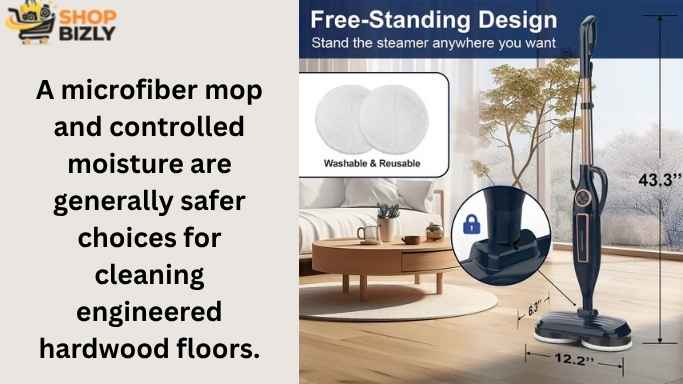
For most homes, a microfiber mop for engineered hardwood floors is one of the safest and most practical choices.
Microfiber can collect dust and debris effectively while allowing you to control how much moisture reaches the surface.
Best options
Dry microfiber mop
Excellent for everyday dust and loose debris.
Spray mop designed for wood floors
Useful when paired with a manufacturer-approved or compatible wood-floor cleaner.
Lightly damp microfiber mop
Good for occasional cleaning when used carefully.
Mops to use cautiously or avoid
- Traditional soaking-wet string mops
- Steam mops without explicit manufacturer approval
- Abrasive scrub pads
- Mop heads that leave excessive water behind
Bona’s guidance emphasizes using cleaning products designed for the floor type and avoiding excess liquid on wood floors. It also recommends microfiber cleaning systems for wood floor care.
Can You Use a Steam Mop on Engineered Hardwood Comparison Table: Best Cleaning Methods
| Cleaning Method | Moisture Level | Suitable for Most Engineered Hardwood? | Notes |
| Dry microfiber mop | Very low | Yes. | Best for regular dust removal |
| Soft broom | Very low | Yes. | Use gently |
| Bare-floor vacuum setting | Very low | Usually | Avoid settings that can scratch. |
| Lightly damp microfiber mop | Low | Usually | Follow manufacturer guidance. |
| Wood-floor spray mop | Controlled | Usually | Use a compatible cleaner. |
| Traditional wet mop | High | No | Excess water is risky. |
| Steam mop | Heat + moisture | Usually no | Use only with explicit product approval. |
7. How Do You Deep Clean Engineered Hardwood Floors?
Deep cleaning does not have to mean aggressive cleaning.
In fact, the safest deep-cleaning method usually involves better technique, not more water.
Step 1: Vacuum or dust thoroughly.
Pay special attention to:
- Corners
- Under furniture edges
- Around rugs
- Plank grooves
- High-traffic pathways
For how to clean engineered hardwood floors with deep grooves, use a soft brush attachment if appropriate for your vacuum, or gently work loose debris from grooves without scratching the finish.
Step 2: Spot-clean stubborn marks
Apply only a small amount of an approved cleaner to a microfiber cloth or according to the cleaner’s directions.
Avoid pouring liquid directly onto the floor.
Step 3: Clean in manageable sections.
Work across small areas so moisture does not remain on the floor for long.
Step 4: Dry if needed
If you notice visible moisture, buff the area with a clean, dry microfiber cloth.
This method is usually safer than trying to blast stubborn dirt away with hot steam.
8. Helpful Tips for Keeping Engineered Hardwood Floors Clean
Use entry mats.
Dirt and grit can act like sandpaper under shoes.
Place mats near entrances and clean them regularly.
Protect furniture legs.
Use suitable felt pads under chairs and furniture.
Clean spills immediately.
The faster you remove moisture, the less time it has to reach vulnerable areas.
Keep cleaning pads clean.
A dirty pad can drag grit across the floor.
Wash or replace microfiber pads as needed.
Do not over-clean.
Using strong chemicals or excessive moisture too frequently can be harder on the floor than normal household dirt.
Can You Use a Steam Mop on Engineered Hardwood? Follow your manufacturer’s schedule.
Your floor’s finish and construction may have specific maintenance requirements.
This is especially important for newly installed, specialty-finished, or premium engineered wood floors.
9. Natural Way to Clean Engineered Hardwood Floors: Is Vinegar a Good Idea?
Many DIY cleaning guides recommend vinegar and water.
However, “natural” does not automatically mean “safe for your floor.”
Bona advises against using vinegar on hardwood floors because its acidity can dull or damage the finish over time. It also recommends avoiding homemade solutions containing potentially damaging ingredients.
A safer approach is
- Dry microfiber for routine cleaning
- Prompt spill cleanup
- A manufacturer-approved cleaner when needed
- Controlled, minimal moisture
Before trying baking soda, vinegar, dish soap, essential oils, or another homemade mixture, check your flooring manufacturer’s instructions.
10. Common Mistakes When Cleaning Engineered Hardwood
Mistake #1: Assuming engineered wood is waterproof
Engineered hardwood may be more stable than solid wood, but it is still not automatically safe from moisture damage.
Mistake #2: Using a steam mop because it says “safe for sealed floors”
“Sealed floors” can include many different materials.
That label does not necessarily mean your specific engineered hardwood is approved for steam.
Mistake #3: Using too much water
A mop should not leave the floor wet.
Mistake #4: Ignoring scratches and worn finish
Damaged areas can be more vulnerable to moisture.
Mistake #5: Using a vacuum with the wrong setting
Aggressive brushes or beater bars may scratch certain floors.
Mistake #6: Leaving spills to dry naturally
Quick cleanup is safer.
Mistake #7: Copying advice meant for vinyl
Your previous research into steam mops for vinyl plank floors and steam mops for vinyl floors may be useful for those surfaces, but wood flooring requires its own cleaning rules.
Best Steam Mop for Vinyl Plank Floors
Mistake #8: Ignoring the warranty
Always check the official maintenance instructions before using a new cleaning machine.
Can You Use a Steam Mop on Engineered Hardwood? Pros and Cons of Using a Steam Mop on Engineered Hardwood
Pros
- Fast cleaning on approved surfaces
- No bucket required
- Can reduce reliance on some chemical cleaners
- Convenient for certain non-wood flooring types
Cons
- Heat and moisture can be risky for wood
- Steam may enter seams and damaged areas
- May affect the finish over time
- Could conflict with manufacturer care instructions
- May create warranty concerns
- A safer microfiber method is usually available
For most engineered hardwood owners, the risks outweigh the convenience unless the flooring manufacturer specifically approves steam cleaning.
Can You Use a Steam Mop on Engineered Hardwood?
EEAT: How We Evaluated This Advice
This guidance is based on a practical comparison of recommendations from recognized wood-floor and cleaning organizations, together with manufacturer floor-care guidance.
The National Wood Flooring Association recommends routine dry cleaning methods and warns against wet and steam mops on wood floors. The American Cleaning Institute says steam mops are generally not recommended by the hardwood flooring industry and advises following the manufacturer’s cleaning recommendations. Bona’s wood-floor care guidance also advises avoiding steam cleaners and excess water.
Can You Use a Steam Mop on Engineered Hardwood? Frequently Asked Questions
1. What is the best thing to use to clean engineered hardwood floors?
For everyday cleaning, a dry microfiber mop is an excellent choice for removing dust and grit. For deeper cleaning, use a lightly damp microfiber mop and a cleaner approved by your flooring manufacturer. Avoid excessive water and check your care instructions before using any new cleaning product.
2. What type of mop is best for cleaning engineered hardwood floors?
A soft microfiber mop is usually one of the best options. It can be used dry for routine dusting or lightly damp for approved cleaning. A wood-floor spray mop can also be a good choice when used with a compatible cleaner.
3. How do I clean engineered hardwood floors?
Start by removing loose dust with a microfiber mop, broom, or suitable vacuum setting. Clean spills promptly. When needed, use a manufacturer-approved wood-floor cleaner with a lightly damp microfiber mop. Avoid soaking the floor and allow it to dry quickly.
4. What is the best steam cleaner for engineered hardwood floors?
For most engineered hardwood floors, the safest answer is that you should not choose a steam cleaner unless your exact flooring manufacturer explicitly approves steam cleaning. If approval exists, follow the manufacturer’s instructions exactly rather than relying on general steam mop recommendations.
5. Can you mop engineered hardwood floors?
Yes, but avoid soaking the floor. Use a lightly damp microfiber mop and a cleaner appropriate for the specific finish. Excess water and steam are generally not recommended for wood flooring unless the manufacturer states otherwise.
Can You Use a Steam Mop on Engineered Hardwood? Conclusion: Should You Use a Steam Mop on Engineered Hardwood?
So, can you use a steam mop on engineered hardwood?
For most floors, no—it is better to avoid it.
The fact that engineered hardwood is built differently from solid hardwood does not mean it is automatically safe for high heat and steam. Moisture can still reach seams, edges, worn finishes, and other vulnerable areas. Repeated exposure may create problems that are not immediately visible.
The safest routine is usually much simpler:
- Remove dust and grit with a dry microfiber mop.
- Clean spills quickly.
- Use minimal moisture.
- Choose a cleaner designed for wood flooring and approved for your floor where possible.
- Follow the exact care instructions from your flooring manufacturer.
The most important takeaway is this: your flooring manufacturer’s instructions should always beat generic cleaning advice.
Can You Use a Steam Mop on Engineered Hardwood?
If the manufacturer explicitly approves steam cleaning for your exact engineered hardwood product, follow those instructions carefully. If the guide says nothing about steam—or tells you to avoid it—stick with a microfiber mop and a safer wood-floor cleaning method.