
How to Clean Laminate Floors Without Damage: A Safe Step-by-Step Guide
Laminate floors are popular because they give a home the warm, stylish look of hardwood without requiring the same level of maintenance. But there is one catch: cleaning laminate floors the wrong way can cause problems that are much harder to fix than ordinary dirt.
Too much water can work its way into seams. Abrasive dirt can create tiny scratches. The wrong cleaner may leave a dull film or streaks. And popular cleaning methods such as steam mopping or homemade vinegar solutions are not automatically safe for every laminate floor.
So, how do you clean laminate floors without damage?
The safest approach is surprisingly simple: remove dry dirt first, use as little moisture as possible, choose a cleaner designed or approved for laminate, clean with a soft microfiber pad, and dry any remaining moisture promptly. Always check your flooring manufacturer’s care instructions before trying a new cleaning method.
Bona’s laminate-care guidance recommends removing loose dirt before damp cleaning, keeping cleaning tools damp rather than wet, avoiding excess liquid, and avoiding soap-based or vinegar-and-water cleaning solutions. The Home Depot similarly recommends regular sweeping or vacuuming, sparing use of water, and a lightly damp mop rather than soaking the floor.
This guide will show you exactly how to clean laminate floors without damage, how to deep clean very dirty floors, what to use for shine, whether vinegar is safe, which cleaners to avoid, and how to choose the best laminate floor cleaning solution.
How to Clean Laminate Floors Without Damage Table of Contents
- What Makes Laminate Floors Different?
- What You Need to Clean Laminate Floors Safely
- How to Clean Laminate Floors Without Damage
- How to Deep Clean Very Dirty Laminate Floors
- How to Make Laminate Floors Clean and Shiny
- Does Vinegar Damage Laminate Floors?
- What Not to Use to Clean Laminate Floors
- Best Laminate Floor Cleaning Solution
- Pros and Cons of Different Cleaning Methods
- Helpful Tips for Long-Lasting Laminate Floors
- Common Laminate Floor Cleaning Mistakes
- FAQ
- Conclusion
How to Clean Laminate Floors Without Damage What Makes Laminate Floors Different?
Before learning how to clean laminate flooring, it helps to understand why laminate needs a slightly different cleaning routine.
Laminate flooring may look like real wood, but its construction is different. The visible surface is a decorative layer protected by a wear layer, while the core underneath can be more vulnerable to prolonged moisture.
That is why more water does not mean a cleaner floor.
In fact, standing water can cause swelling, bubbling, seam problems, or other damage depending on the construction and water resistance of the flooring. The Home Depot specifically recommends using water sparingly because standing water can cause laminate floors to bubble, swell, separate at seams, or fade.
This does not mean laminate can never be damp cleaned. It means you should control moisture carefully.
A good rule is
Clean the dirt, not the floor with water.
In other words, use enough moisture to remove grime, but not enough to leave puddles or wet seams behind.
What You Need to Clean Laminate Floors Safely
You don’t need a large collection of expensive cleaning products to maintain laminate flooring.
1. Microfiber Dust Mop
A microfiber dust mop is one of the easiest tools for everyday laminate floor care.
It picks up dust, hair, and loose particles without requiring water. Regular dry cleaning also reduces the amount of gritty debris that gets dragged across the floor.
Bona recommends microfiber dusting pads for laminate and notes that regular dry dusting can make wet and deep cleaning easier.
2. Vacuum With a Hard-Floor Setting
A vacuum can be excellent for laminate floors, but use the right attachment.
Look for:
- Soft-bristle floor attachment
- Hard-floor setting
- No aggressive rotating beater bar
- Clean wheels that won’t drag grit across the floor
The Home Depot recommends using a soft-brush attachment and a hard-floor setting to reduce the risk of scratching.
3. Microfiber Mop
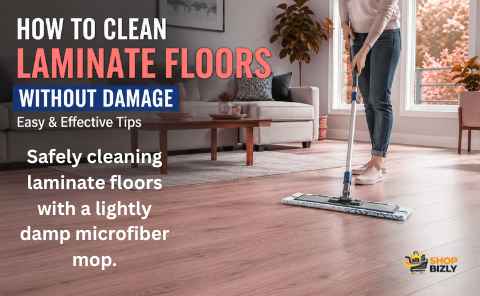
For damp cleaning, a microfiber mop is usually a practical choice because you can control how much moisture reaches the floor.
The mop should be damp, not dripping wet.
4. Laminate-Safe Floor Cleaner
For routine cleaning, choose a product specifically labeled for laminate or compatible hard surfaces.
Bona currently offers cleaners intended for laminate and other hard-surface floors.
Always read your flooring manufacturer’s instructions before choosing a cleaning chemical.
5. Dry Microfiber Cloth
Keep a clean, dry microfiber cloth nearby for spills, stubborn spots, and any moisture left behind after cleaning.
How to Clean Laminate Floors Without Damage
Now let’s get to the actual cleaning process.
How to Clean Laminate Floors Without Damage
The following routine is simple enough for regular maintenance but effective enough to handle most everyday dirt.
Step 1: Remove Furniture and Small Objects
Before cleaning, pick up toys, shoes, small furniture, and anything else sitting on the floor.
You don’t need to move every heavy piece of furniture every time, but clearing the walking area makes cleaning much easier.
Use felt pads or appropriate furniture protectors under furniture legs to reduce scratching when items are moved.
Step 2: Remove Dust, Hair, and Grit
Start with a dry microfiber dust mop or a vacuum with a soft floor attachment.
Do not skip this step.
Small particles of sand, grit, and dirt can act like abrasives when they are dragged underneath a mop or shoe.
Bona specifically recommends removing dirt and debris before wet cleaning because these particles can scratch flooring surfaces.
Pay extra attention to:
- Entryways
- Kitchen areas
- Under dining tables
- Around pet bowls
- Hallways
- Areas near exterior doors
Step 3: Choose the Right Cleaner
For routine cleaning, a laminate-approved cleaner is generally the easiest option.
Avoid choosing a product simply because it says “wood cleaner.” Laminate and hardwood are not identical surfaces.
A cleaner should be compatible with your flooring.
If your laminate manufacturer recommends a specific product, follow that recommendation first.
Step 4: Use Very Little Moisture
This is probably the most important part of cleaning laminate floors without damage.
Apply a small amount of cleaning solution to your microfiber mop according to the product instructions.
Your mop should be damp—not soaking wet.
Do not flood the floor.
Step 5: Mop in Small Sections
Work in manageable sections instead of covering the entire room with cleaning solution at once.
Move the microfiber mop gently across the floor.
There’s no need to scrub aggressively.
For stubborn dirt, slow down and make another pass rather than attacking the surface with a rough pad.
Step 6: Wipe Up Remaining Moisture
After damp cleaning, inspect the floor.
If you see visible moisture, wipe it with a clean microfiber cloth or dry mop.
Drying the floor promptly is especially important around seams and edges.
Step 7: Let the Room Ventilate
Good airflow can help remaining moisture evaporate more quickly.
Open a door or window if practical, especially after a more thorough cleaning.
How to Deep Clean Very Dirty Laminate Floors
What if regular dusting and light mopping aren’t enough?
If your laminate floor has accumulated greasy residue, footprints, or sticky dirt, you can deep clean it—but deep cleaning does not mean soaking the floor.
Start With Dry Cleaning
Vacuum or dust mop first.
Trying to remove heavy dirt with a wet mop can turn loose grit into muddy residue that spreads across the floor.
Treat Stubborn Areas Separately
Instead of applying a large amount of cleaner to the entire room, focus on visibly dirty areas.
Use a laminate-compatible cleaner and a microfiber cloth or appropriate cleaning pad.
Work gently.
For sticky residue, allow the recommended cleaner to loosen the contamination rather than scrubbing harder.
Follow With a Light Damp Clean
Once the stubborn spots are addressed, lightly dampen and clean the rest of the floor.
Keep moisture under control.
How to Clean Laminate Floors Without Damage Dry the Floor
Use a clean microfiber towel or dry mop if necessary.
The goal is to finish with a clean floor—not a wet floor.
For very dirty floors, repeating a controlled cleaning pass is usually safer than using excessive water or aggressive chemicals.
How to Make Laminate Floors Clean and Shiny
A common question is
How do I make my laminate floors clean and shiny?
The answer may be different from what you expect.
You usually don’t need wax or polish to create shine.
In fact, some laminate-care guidance specifically recommends avoiding wax, polish, and “clean and shine” products because they can leave residue or dull the appearance. Bona advises against wax on laminate and warns that all-in-one clean-and-shine products can leave streaks or residue.
Instead, focus on removing the things that make laminate look dull:
- Dust
- Grease
- Cleaning residue
- Soap film
- Excess moisture
- Footprints
- Fine grit
A clean microfiber pad and the correct amount of cleaner can often make a bigger visual difference than adding a polishing product.
How to Avoid Streaks
If your laminate floor looks streaky after cleaning:
- Check whether you are using too much cleaner.
- Avoid soap-heavy products.
- Make sure the microfiber pad is clean.
- Remove excess moisture.
- Don’t repeatedly mop dirty floors with the same contaminated pad.
Bona recommends avoiding soap-based solutions because they can cause streaking, dullness, or clouding.
How to Clean Laminate Floors Without Damage Does Vinegar Damage Laminate Floors?
This is one of the most confusing questions about laminate floor cleaning.
You’ll find DIY recipes online recommending vinegar and water, but that doesn’t mean vinegar is universally appropriate for every laminate floor.
Bona’s current guidance for cleaning laminate specifically says to avoid the DIY combination of vinegar and water, explaining that vinegar is acidic and may affect the protective finish.
At the same time, some individual flooring-care documents have historically provided vinegar-based cleaning recipes for specific laminate products. For example, a TrafficMASTER care document gives a diluted vinegar option for its particular flooring.
So the safest answer is
Do not assume vinegar is safe for your laminate floor just because an online DIY recipe recommends it. Check your flooring manufacturer’s instructions first.
If the manufacturer doesn’t recommend vinegar, choose a laminate-approved cleaner instead.
This is especially important if your goal is long-term protection rather than simply getting through one cleaning session.
How to Clean Laminate Floors Without Damage What About DIY Laminate Floor Cleaning?
If you specifically want a DIY solution, start with your flooring manufacturer’s care instructions.
Plain water may be sufficient for light cleaning on some floors when used sparingly, while other floors may require a recommended cleaner.
The important thing is to avoid experimenting with acidic mixtures, excessive water, or harsh chemicals without knowing how your particular laminate surface reacts.
How to Clean Laminate Floors Without Damage What Not to Use to Clean Laminate Floors
Knowing what not to use can prevent expensive mistakes.
1. Excess Water
This is one of the biggest problems.
Don’t flood laminate floors or leave standing water behind.
2. Abrasive Scrubbers
Avoid steel wool, scouring powders, and aggressive scrub pads.
These can scratch the protective surface.
3. Wax and Polish
Laminate floors generally do not need traditional waxing or polishing.
Some manufacturers specifically warn against them.
4. Oil-Based Cleaners
Oil-based products can leave a film or residue and may make the floor look streaky.
5. Harsh Chemicals
Don’t assume a stronger chemical will produce a better clean.
Harsh or acidic cleaners can damage some flooring finishes.
6. Steam Mop Without Manufacturer Approval
This one needs a special explanation.
There is no universal answer for every laminate floor.
Shaw’s laminate-care guidance says not to use steam cleaners or wet mops because moisture can enter plank joints and cause damage.
However, Pergo’s current care document says steam cleaners can be used on certain Pergo laminate floors with a 15-year wet warranty when used at low power, with an appropriate cloth covering the steam openings, while cleaning in the direction of the planks and avoiding prolonged contact in one spot.
Therefore:
Never assume a steam mop is safe simply because the floor is called laminate. Check the exact manufacturer’s instructions for your flooring.
If the manufacturer doesn’t explicitly approve steam cleaning, the safer choice is to skip the steam mop.
How to Clean Laminate Floors Without Damage Best Laminate Floor Cleaning Solution
There isn’t one universal “best” cleaner for every laminate floor.
The safest choice is a product that:
- Is specifically labeled for laminate
- Is compatible with your floor manufacturer’s instructions
- Doesn’t leave a heavy residue
- Can be used with minimal moisture
- Is easy to apply with a microfiber mop
Laminate Floor Cleaner vs. DIY Solution
| Cleaning Method | Best For | Main Advantage | Main Concern |
|---|---|---|---|
| Laminate-approved cleaner | Regular cleaning | Convenient and formulated for the surface | Follow label directions. |
| Plain water | Light routine cleaning | Simple and inexpensive | Excess water is still a problem. |
| DIY vinegar solution | Only where the manufacturer permits | Low-cost option | Not universally recommended |
| Microfiber + minimal moisture | Everyday maintenance | Excellent moisture control | Requires regular cleaning |
| Steam mop | Only approved laminate | Convenient deep cleaning | Manufacturer restrictions vary. |
Bona Laminate Floor Cleaner
Bona is one of the better-known floor-care brands, and its current product range includes cleaners designed for laminate and hard-surface flooring. Bona also recommends microfiber cleaning pads for laminate.
If you’re considering a Bona product, make sure the exact cleaner you purchase is labeled for your floor type.
Zep Laminate Floor Cleaner
Zep also has a hardwood and laminate floor cleaner sold through major retailers. Its product instructions should be followed exactly, especially regarding whether the product is ready-to-use or intended for dilution.
The important point is not that one brand is automatically better than every other option.
Compatibility with your laminate floor matters more than the brand name.
How to Clean Laminate Floors Without Damage Pros and Cons of Different Laminate Cleaning Methods
| Method | Pros | Cons |
| Dry microfiber mop | Fast, gentle, great for daily dust | Won’t remove sticky grime |
| Soft-brush vacuum | Removes hair and grit efficiently | Wrong attachment can scratch |
| Damp microfiber mop | Good for regular cleaning | Too much water can cause problems. |
| Laminate-safe cleaner | Convenient for deeper cleaning | Must follow product instructions |
| Vinegar DIY | Cheap and popular online | Not recommended by some manufacturers |
| Steam mop | Fast and convenient on approved floors | Unsafe for some laminate products |
| Wax/polish | Can create temporary shine | May leave residue or damage appearance |
Helpful Tips for Long-Lasting Laminate Floors
Use Entry Mats
Place mats near exterior doors.
Sand, grit, and dirt are among the easiest ways to create surface wear.
Clean Spills Quickly
Don’t wait for a spill to dry if it can be wiped immediately.
A microfiber cloth is usually enough for a small spill.
Keep Pet Nails Trimmed
Pet nails can create scratches, especially in high-traffic areas.
Use Furniture Pads
Felt pads or appropriate furniture protectors can reduce scratches from chairs and tables.
Don’t Drag Heavy Furniture
Lift furniture when possible.
Dragging a heavy object can scratch or dent laminate.
Clean High-Traffic Areas More Often
You don’t necessarily need to deep clean the entire house on the same schedule.
Entryways, kitchens, and hallways usually collect more dirt.
Use a Clean Mop Pad
A dirty microfiber pad can simply redistribute grime.
Wash or replace the pad regularly.
Always Check Your Flooring Warranty
This is particularly important before using steam, chemicals, or specialized cleaning machines.
Different laminate products can have different water resistance and maintenance requirements.
Common Laminate Floor Cleaning Mistakes
Mistake 1: Using Too Much Water
More water doesn’t equal more cleaning power.
It can increase the chance of moisture entering seams.
Mistake 2: Skipping Vacuuming
Mopping directly over sand and grit can drag abrasive particles across the floor.
Mistake 3: Using Too Much Cleaner
Excess cleaner can leave residue and streaks.
Mistake 4: Using a Dirty Mop Pad
A dirty pad spreads old grime instead of removing it.
Mistake 5: Treating Laminate Like Hardwood
Laminate and hardwood may look similar, but their care requirements aren’t identical.
Mistake 6: Automatically Using Vinegar
Online DIY recipes are not a substitute for your flooring manufacturer’s instructions.
Mistake 7: Automatically Using a Steam Mop
Some laminate products allow controlled steam cleaning; others specifically prohibit it. Always check first.
Mistake 8: Trying to Create Shine With Wax
A clean laminate floor should not require a layer of wax to look good.
Frequently Asked Questions
1. What is the safest way to clean laminate floors?
The safest general method is to remove loose dirt with a soft-bristle vacuum or microfiber dust mop, then use a lightly damp microfiber mop with a laminate-compatible cleaner. Avoid excess water and dry remaining moisture promptly. Always follow the manufacturer’s care instructions.
2. How do you deep clean dirty laminate floors?
Start by vacuuming or dusting thoroughly. Treat stubborn spots individually with a laminate-compatible cleaner, then lightly damp mop the floor using a microfiber pad. Avoid soaking the surface and remove remaining moisture when you’re finished.
3. How do I make my laminate floors clean and shiny?
The best approach is to remove dust, dirt, and cleaning residue rather than covering the floor with wax or polish. Use a clean microfiber pad, the correct amount of laminate-safe cleaner, and minimal moisture. Avoid products that leave a film.
4. Does vinegar damage laminate floors?
It depends on the specific flooring product and its manufacturer’s care instructions. Some flooring documents have allowed diluted vinegar for particular products, while other current laminate-care guidance recommends avoiding vinegar-and-water mixtures. Because of that difference, don’t assume vinegar is universally safe.
5. Can I use a steam mop on laminate floors?
Only if your specific laminate manufacturer explicitly allows it. Some laminate products prohibit steam cleaning, while certain Pergo products with specified water-resistance warranties permit low-power steam cleaning under particular conditions.
EEAT: What Makes This Cleaning Advice Trustworthy?
Cleaning advice is often filled with conflicting DIY recommendations. That’s why the safest approach is to compare practical cleaning guidance with manufacturer instructions.
For this guide, recommendations have been checked against guidance from established floor-care and home-improvement sources, including Bona, Pergo, and The Home Depot.
The most important takeaway from comparing these sources is that laminate flooring is not one identical product.
Water resistance, surface construction, and warranty requirements can differ.
That’s why a good cleaning routine should always begin with the manufacturer’s care instructions for your exact floor.
This is especially important for controversial cleaning methods such as vinegar and steam.
A Simple Laminate Floor Cleaning Routine
If you don’t want to overthink your cleaning routine, use this simple system:
Daily or as needed:
- Remove visible dirt and spills
- Dry dust mop high-traffic areas
Weekly:
- Vacuum with a soft floor attachment
- Pay extra attention to entryways and kitchens
When needed:
- Lightly damp mop with a laminate-compatible cleaner
- Use minimal moisture
- Dry remaining moisture
Occasionally:
- Deep clean stubborn areas
- Check furniture pads and entry mats
- Inspect the floor for scratches or moisture damage
The exact frequency depends on how much traffic your home receives, whether you have pets, and how much dirt enters the house.
Conclusion
Learning how to clean laminate floors without damage doesn’t require a complicated cleaning system.
The biggest difference comes from using the right amount of moisture and avoiding cleaning products or methods that your particular flooring doesn’t allow.
Start by removing dry dirt with a microfiber dust mop or soft-brush vacuum. Then use a lightly damp microfiber mop and a cleaner that is compatible with your laminate floor. Avoid standing water, abrasive tools, wax, and unnecessary harsh chemicals.
And when it comes to the two questions homeowners ask most—vinegar and steam mops—don’t rely on a generic internet recipe. Check your flooring manufacturer’s instructions first. Current guidance varies between laminate products, which is exactly why a one-size-fits-all answer can be misleading.
If your laminate floor is looking dull, the solution usually isn’t more polish. Remove the residue, control moisture, use a clean microfiber pad, and keep up with regular dry cleaning.
A simple, consistent routine is usually the best way to keep laminate floors looking clean, comfortable, and well maintained for years.